Human vs. Automated Quality Assurance for Legal AI: Lessons from Evaluating a Legal Chatbot
By
Karim Alain El Sayed
|
Blog

As Legal AI systems become increasingly sophisticated, a critical question emerges: can the quality assurance (QA) of legal chatbots be fully automated, or does human expertise remain essential?
Over the past months, I have been involved in designing and implementing both manual and automated QA processes for Laitron, an AI-powered legal assistant. The experience provided valuable insights not only into Legal AI, but also into a broader challenge facing all high-risk AI applications: how do we reliably evaluate AI systems before we trust them?
The answer, at least for now, is clear: automation drastically improves speed and scalability, but human expertise remains the foundation of trustworthy AI evaluation.
Defining what “good” legal AI looks like
Before evaluating the chatbot itself, we first had to define what quality means in a legal AI context.
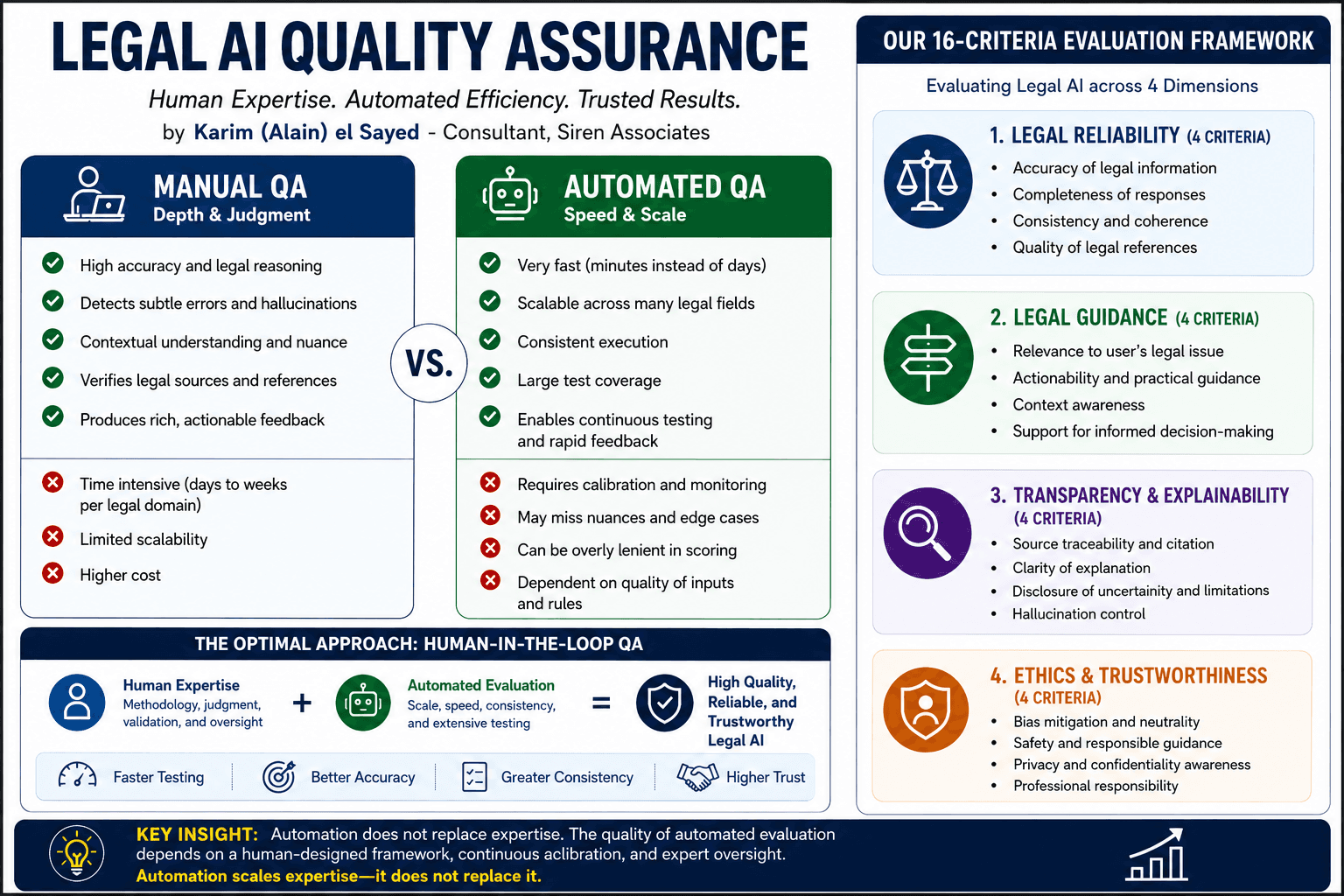
Through legal research, practical experimentation, and iterative refinement, we developed a structured QA framework based on 16 evaluation criteria covering both legal-technical and ethical dimensions.
These criteria were designed to assess whether the chatbot delivers responses that are:
Legally accurate and reliable.
Properly referenced and traceable to legal sources.
Clear, structured, and understandable.
Consistent and coherent across interactions.
Transparent about uncertainty and limitations.
Free from hallucinations and misleading information.
Objective and unbiased.
Helpful in guiding users toward appropriate legal actions.
Ethically responsible and trustworthy.
The methodology also standardized the testing process itself. Each evaluation involved a structured legal conversation beginning with a general legal question and progressing through increasingly detailed follow-up questions designed to test the depth, consistency, and reliability of the system.
The objective was not simply to verify whether the chatbot could answer legal questions, but whether it could provide trustworthy legal guidance.
What manual QA revealed
Manual QA proved remarkably effective at identifying weaknesses that would likely have gone unnoticed through automation alone.
Human assessors were able to verify legal information against official legal sources, evaluate the quality of legal reasoning, assess the relevance of legal references, detect hallucinations, and determine whether the chatbot appropriately acknowledged the limits of available legal information.
Perhaps most importantly, human reviewers could distinguish between an answer that was technically correct and one that was genuinely useful from a legal perspective.
The detailed assessment of each of the 16 criteria generated highly actionable findings that directly contributed to improving the quality of the system.
However, this level of rigor comes at a cost. Depending on the complexity of the legal domain, a comprehensive manual assessment could require days or even weeks of work. In some cases, evaluating a single legal field required up to two weeks of analysis and validation.
The promise of automated QA
To improve scalability, we developed an automated QA platform capable of generating legal conversations and assessing responses against the same evaluation framework.
The operational benefits were significant.
Legal conversations could be generated within minutes. Comprehensive evaluation reports could be produced in less than fifteen minutes. What previously required days or weeks could now be completed in a fraction of the time.
This made large-scale testing possible and significantly accelerated the feedback loop between evaluation and system improvement.
At first glance, this appeared to be a compelling argument for automation.
However, a deeper analysis revealed important limitations.
What the comparison showed
When comparing manual and automated assessments, the automated evaluator was generally effective at identifying major strengths and weaknesses. In many cases, its conclusions were directionally correct.
Yet important differences emerged.
Manual assessments consistently demonstrated a greater ability to:
Detect subtle legal inaccuracies.
Identify hallucinated or misleading legal references.
Evaluate the quality of legal reasoning and argumentation.
Recognize contextual nuances and exceptional cases.
Assess uncertainty where legal interpretation is not straightforward.
Produce richer, more precise, and more actionable recommendations.
By contrast, automated evaluations often displayed a tendency to be more lenient and more likely to assume that the chatbot’s reasoning was correct.
The automated evaluator also required continuous calibration, prompt refinement, monitoring, and methodological adjustments to maintain acceptable levels of objectivity and consistency.
In other words, the automation itself required constant expert supervision.
The most important finding
This experience highlighted the importance of rigorous evaluation before releasing new AI versions. Enhancements should not focus solely on style, fluency, or user experience, but should demonstrate measurable improvements in accuracy, reliability, and trustworthiness.
The most significant lesson from this experience was not that humans outperform AI. It was that the quality of automated evaluation depended almost entirely on a human-designed evaluation framework.
The methodology, evaluation criteria, examples used for calibration, and scoring logic were all designed by humans. Furthermore, the automated evaluator only became effective because it was guided, refined, and continuously improved by human expertise.
Beyond legal AI
Although this experience was conducted within the legal domain, the lessons extend far beyond legal technology.
As AI systems are increasingly deployed in law, healthcare, finance, policing, public administration, and other high-stakes environments, the quality of the evaluation process may become just as important as the quality of the AI system itself.
Organizations often focus on model performance, but trust ultimately depends on robust mechanisms for testing, validating, and governing these systems. The challenge is thus to find smarter ways to evaluate AI.
The future: human-in-the-loop evaluation
The future of Legal AI quality assurance is unlikely to be fully manual or fully automated.
A more realistic and effective approach is a human-in-the-loop model, where human experts continuously supervise, validate, and refine AI outputs. In this model, automated systems perform large-scale testing, identify patterns, and generate preliminary assessments, while legal experts validate complex cases, refine methodologies, and ensure the integrity of the evaluation process.
As AI continues to evolve, trust will become its most valuable asset. Building that trust requires rigorous evaluation frameworks, expert oversight, and a clear understanding of where automation creates value and where human judgment remains irreplaceable.
The lesson from this experience is simple: the goal is not to replace legal experts with AI, but to leverage AI to enhance the reach and effectiveness of human expertise. No AI system should be considered trustworthy solely because it appears more sophisticated or persuasive. Genuine progress must be demonstrated through measurable improvements in accuracy, reliability, and legal soundness, verified through rigorous assessment conducted by independent teams of qualified human experts.